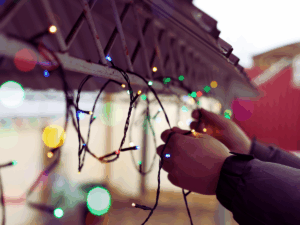
 Most homes want holiday lights outside, but many homes do not have an outdoor outlet.
People still try to light up porches, walkways, and roofs. They try strange workarounds, too.
A cord out a cracked window. A cord under a door. A cord wrapped in plastic bags.
These shortcuts feel simple, but they can damage cords, break insulation, and create fire hazards.
This guide gives you safe options. It explains easy ways to power outdoor Christmas lights.
Quick Takeaways
- You can run Christmas lights without an outdoor outlet using indoor-outdoor extension cords, solar lights, battery-powered lights, stake timers, or light socket adapters.
- Always use outdoor-rated cords and lights to avoid weather damage and electrical hazards.
- Avoid closing windows or doors over extension cords, because crushed insulation can expose wiring.
- Use GFCI protection when you power outdoor lights from an indoor outlet.
- Large displays or multi-circuit setups may need a dedicated outdoor outlet installed by a licensed electrician.
Can You Hang Christmas Lights Without an Outdoor Outlet? The Short Answer
Yes. You can power outdoor Christmas lights without an outdoor outlet. You can pull power from an indoor outlet, use solar lights, run battery-powered lights, or use a porch light socket adapter.
You only need outdoor-rated equipment and a setup that keeps the connection dry and safe. The limits show up fast, though. Weather exposure, small batteries, weak sunlight, and limited load capacity all change how big your display can be.
Safe Ways to Power Christmas Lights Without an Outdoor Outlet
Homeowners have several safe options. You can pick one based on how large your display is and how long you want it to run.
1. Use an Indoor Outlet With an Outdoor-Rated Extension Cord
This is the most common method. Pick an outdoor-rated cord with thick insulation. Run it from an indoor outlet to the outside through a window or door that does not crush the cord.
Keep the cord low and away from footpaths. Use a weatherproof cord cover where the cord exits your home. This protects the plug connection from rain and snow.
2. Use a Window Feed-Through Cable (Low-Profile Cord)
A slim cable lets you close a window without crushing the cord. These cords sit flat and give you a clean pass-through point.
This method works well for apartments and homes where doors cannot stay open even a little. It keeps the insulation intact and keeps the circuit safe.
3. Use Battery-Powered Christmas Lights
Battery-powered lights help small displays. They work well on wreaths, porch railings, bushes, and planters.
You do not need an outlet at all. Batteries drain fast in cold weather, so expect shorter runtimes. You may need to change batteries often if you run the lights every night.
4. Use Solar Christmas Lights
Solar lights can power an entire display if you have steady sunlight. They work well along fences, walkways, and garden beds.
They dim on cloudy days, and short winter daylight reduces charge time. The brightness may drop by the second hour of the night, but they still work for low-power designs.
5. Use a Light-Socket Adapter (Porch Light Adapter)
A porch light can become a temporary power source. A light-socket adapter screws into the fixture and gives you an outlet.
This works only in dry or covered areas. Make sure the socket rating supports the load. You lose the porch light while you use the adapter, but the setup stays simple.
6. Use Smart Plugs or Timers for Indoor-Powered Lights
Smart plugs and timers prevent repeated handling of cords. They switch lights on and off at set times.
They must stay indoors and protected from weather. You can pair a timer with an outdoor-rated extension cord for easy use.
How to Run an Extension Cord Outside Safely
 Most households choose this method, so clear steps matter.
Use Only Outdoor-Rated Extension Cords
Outdoor cords can handle moisture, sunlight, and cold. They have thicker insulation and higher load support. They last longer and prevent shocks.
Keep Cords Off the Ground Where Possible
Cords sitting in water break down fast. Hang the cord or route it across raised surfaces to reduce exposure.
Protect the Plug Connection
Use a weatherproof box or cord dome to keep the connection dry. Even a small amount of water can trip a breaker.
Never Close a Door or Window Directly on a Cord
This crushes the insulation and exposes bare wiring. A crushed cord can spark or heat up.
Power Limits to Understand Before Lighting Your Home
Even if you do not have an outdoor outlet, load limits still matter.
Know Your Circuit Capacity When Using Indoor Power
Most indoor outlets run on 15-amp or 20-amp circuits. A 15-amp circuit supports about 1,440 watts. A 20-amp circuit supports about 1,920 watts.
You must include all indoor loads on that same circuit. A single space heater or TV can take a chunk of that capacity.
LED vs. Incandescent Power Draw
LED lights draw far less power than incandescent lights. LED lights stay cool, save energy, and give you more strands on one circuit. Incandescent lights draw heavy loads and limit your layout.
Example Load Calculation
A typical LED strand pulls about 5 watts. A typical incandescent strand pulls about 40 watts.
If you pull power from a 1,440-watt circuit:
- LED: 1,440 ÷ 5 = 288 strands
- Incandescent: 1,440 ÷ 40 = 36 strands
Real setups use fewer strands because circuits often share devices. Still, the math shows the clear difference.
When You Should Install a Dedicated Outdoor Outlet
Some displays push past temporary solutions.
You may need an outdoor outlet if:
- your breaker trips often
- you run several extension cords
- you want a large display
- cords get damaged each year
- you lack GFCI protection
A dedicated outdoor outlet gives you safe power. It stays weather-ready, clean, and reliable. Genesis 1:3 Electric installs outdoor GFCI outlets that meet code and support holiday lighting and year-round use.
FAQ — How to Do Christmas Lights Without an Outdoor Outlet
Is it safe to plug Christmas lights into an indoor outlet?
Yes. You must use GFCI protection and keep the connection dry.
Can I run an extension cord through a window?
Yes, but you need a flat feed-through cord. Never crush a standard cord with a window.
Are battery-powered lights strong enough for outdoor displays?
They work well for small areas. They dim faster in cold weather.
Will solar Christmas lights stay bright in winter?
They work, but low daylight reduces charge time and brightness.
Can I use a power strip for outdoor lights?
Most power strips are indoor-only. They cannot handle moisture.
How do I keep the cord connection dry?
Use a weatherproof box or protective dome.
Need a Proper Outdoor Outlet for Your Christmas Lights? Call Genesis 1:3 Electric.
 If you want safe holiday lighting without the hassle of workarounds, a real outdoor outlet solves the problem. Genesis 1:3 Electric installs GFCI outdoor outlets for homes in Centennial, CO and nearby communities.
We keep your display bright, simple, and safe. Genesis keeps you out of the dark.